Pneumatic pumps are crucial equipment in various industrial operations. They stand out for their versatility, efficiency and ability to deal with a wide range of liquids, from the simplest to the highly corrosive. This article details the types of liquids that can be transferred, the differences between them, recommended materials, specific applications, and operational considerations.
Types of transferred liquids
Double diaphragm pumps are designed to handle liquids of different natures:
- Visious liquids:
- Examples: Paints, oils, adhesives.
- Challenge: High viscosity can make flow difficult, requiring a system with greater suction and pressure capacity. Pumps must have adequate diaphragms and valves to prevent clogging.
- Chemicals:
- Examples: Acids (such as sulfuric acid), bases (such as sodium hydroxide), and solvents (such as acetone).
- Challenge: The corrosiveness of these liquids requires the choice of resistant materials, such as stainless steel or engineering plastics, and attention to chemical compatibility.
- Suspensions:
- Examples: Sludge, pulp, liquids with suspended solids.
- Challenge: The presence of solids can lead to wear on the internal parts of the bomba. Filtration systems may be required to protect valves and diaphragms.
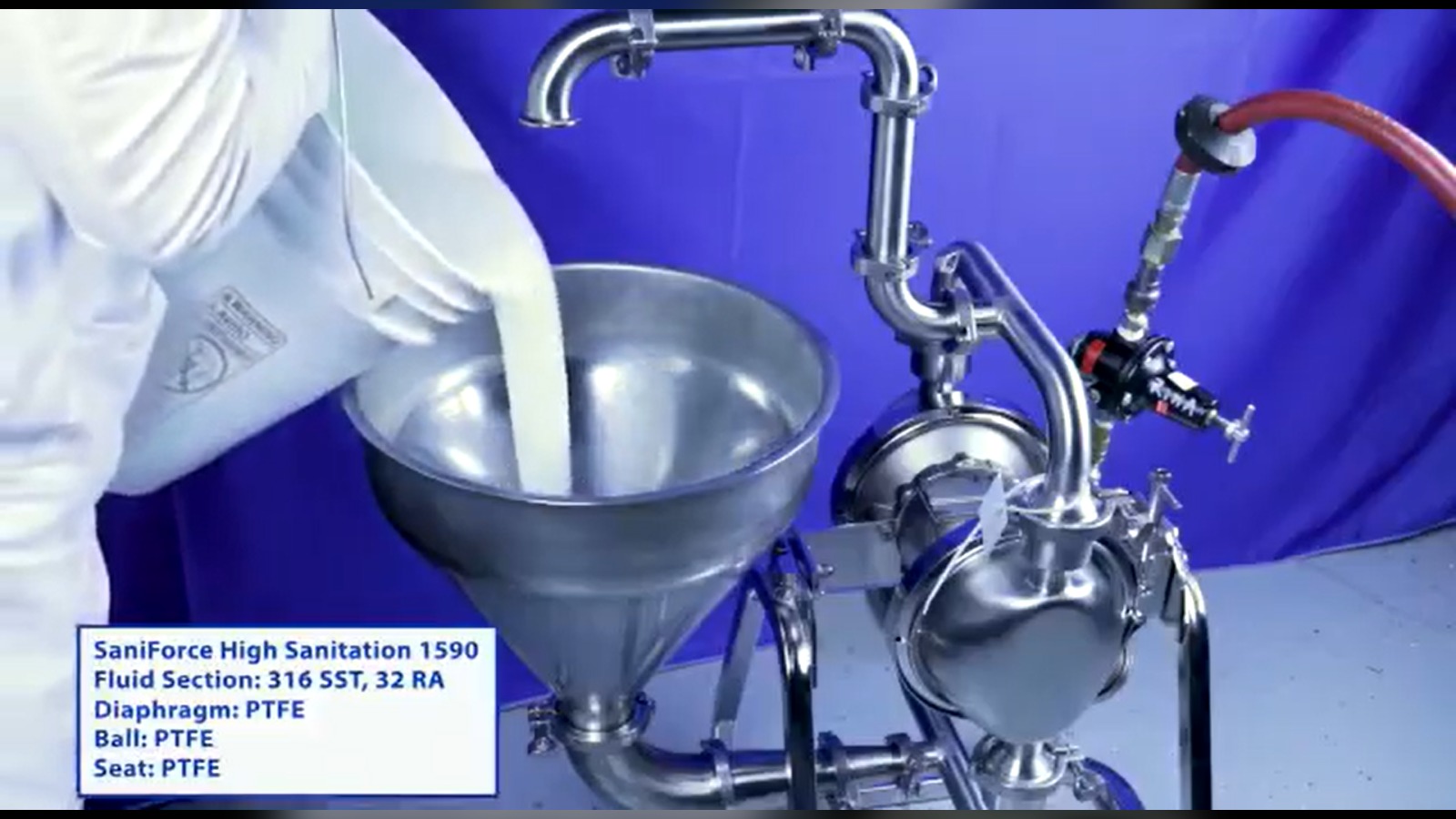
- Food fluids:
- Examples: Edible oils, syrups, sauces.
- Challenge: It is essential that the pumps meet food safety standards, using materials that do not contaminate the products.
Differences in liquids
The differences between liquids directly influence the operation of the pumps:
- Viscosity: The higher the viscosity, the more power the pump must have. High pressure models and self-priming capabilities are essential.
- Corrosivity: Chemicals require pumps with special coatings. For example, for strong acids, the use of Teflon (PTFE) may be necessary to protect internal surfaces.
- Particle size: Liquids with large particles can damage valves and diaphragms. It is important to consider the pump design and component specifications.
Indicated materials
The choice of pump material is essential to guarantee its performance and durability:
- Stainless steel:
- Advantages: Excellent corrosion resistance and high mechanical strength. Ideal for demanding environments.
- Applications: Food, pharmaceutical and petrochemical industries.
- Plastics:
- Examples: Polypropylene, PVC and PTFE.
- Advantages: Lightweight and resistant to many chemicals. Good option for less severe applications.
- Applications: Chemical and water treatment industries.
- Aluminum:
- Advantages: Lightweight and cost-effective.
- Limitations: Less resistant to corrosion, suitable for non-aggressive liquids.
- Applications: General use in controlled environments.
Advantages
- Self -school: The ability to start operation without the need for an additional vacuum source is a great advantage in processes where liquid suction is difficult.
- Operational security: Pneumatic operation eliminates electrical risks, making them ideal for dangerous environments, such as petrochemical industries and areas at risk of explosion.
- Versatility: They can be used to pump liquids of different characteristics, allowing rapid adaptation to different production processes.
- Low maintenance: With fewer moving parts and a simple design, double diaphragm pumps generally require less maintenance compared to other types of pumps.
Specific applications
Double diaphragm pumps are used in several industries, including:
- Chemical industry: Transfer of chemicals, process fluids and pollution control.
- Food industry: Handling ingredients, liquid ingredients and finished products.
- Pharmaceutical: Transfer of active ingredients and process control in sterile environments.
- Water treatment: Pumping sludge and chemicals for effluent treatment.
Operational considerations
When using double diaphragm pumps, it is essential to consider:
- Flow capacity: Choose a pump with the appropriate capacity for the specific application, avoiding overloads.
- Fluid temperature: Check the compatibility of the pump material with the liquid temperature.
- Regular maintenance: Implement a preventive maintenance program to ensure continuous and efficient pump operation.
- Performance Monitoring: Use monitoring systems to track efficiency and detect problems before they become critical.