Why is it important to empty high viscosity drums? — Empty high viscosity drum guide
The most expensive questions about emptying high viscosity drums are not the most complex, but the ones that no one asks at the right time. In the food, cosmetics, pharmaceutical and chemical industries, efficiency in the use of high-value raw materials is one of the most critical factors for the profitability of the operation. However, the handling and transfer of high-viscosity fluids — such as tomato paste, peanut butter, fruit concentrate, mascara, ointments, syrups and gels — presents a recurring technical challenge: wasted product trapped in the bottom and walls of 200-liter drums.
Products such as tomato paste, peanut butter, fruit concentrates, ointments, gels, syrups and creams present a recurring challenge: the difficulty of transferring high-viscosity fluids without leaving residues on the bottom and walls of the drums.
In addition to direct waste, this difficulty can increase the consumption of water and cleaning products, prolong cleaning stops and increase operating costs.
It is estimated that traditional emptying methods (by gravity, manual tilting or suction by conventional pneumatic pumps) leave behind between 5% and 12% of raw material accumulated in the container. In addition to the direct financial loss, this retention requires exhaustive washing, increasing water consumption, line setup time and the generation of effluents.
In this article, we explain why dense fluids behave the way they do and how automated plate-follower unloading technology can recover up to 99% of your product.
The Rheological Challenge: Why Are Dense Fluids Difficult to Pump?
High viscosity products often have non-Newtonian behavior (such as pseudoplastic or thixotropic fluids). This means that its resistance to flow varies depending on the deformation rate or resting time:
High Initial Resistance: When the product is static inside the drum, it acts almost like a solid, making it difficult to suction with common pumps.
Cavitation at the Entrance of Bomba: As the fluid does not flow spontaneously to the suction point, the pump begins to draw in air, generating air pockets, cavitation and instant loss of flow.
Adhesion to Walls: The viscosity causes the product to stick to the grooves and the bottom of the metal or plastic container.
How Much Money Is Retained in the Bottom of the Drum?
To visualize the economic impact on your plant, consider the following practical calculation:
Volume per drum: 200 liters (or ~200 kg)
Average input price: R$50.00 per kg/liter
Estimated loss in the traditional method (7%): 14 kg per drum retained at the bottom
Loss per drum: R$ 700.00
Monthly processing: 50 drums/month
Accumulated annual loss: R$ 420,000.00 discarded or washed in the effluent
By adopting a technology that achieves 99% evacuation, the recovery of raw materials pays for the equipment investment in a few months of operation. Write editorial content here with depth and clarity…
The Technical Solution: The Graco SaniForce Drum Spillway
To resolve this bottleneck, the American manufacturer Graco developed the SaniForce Drum Unloader line.
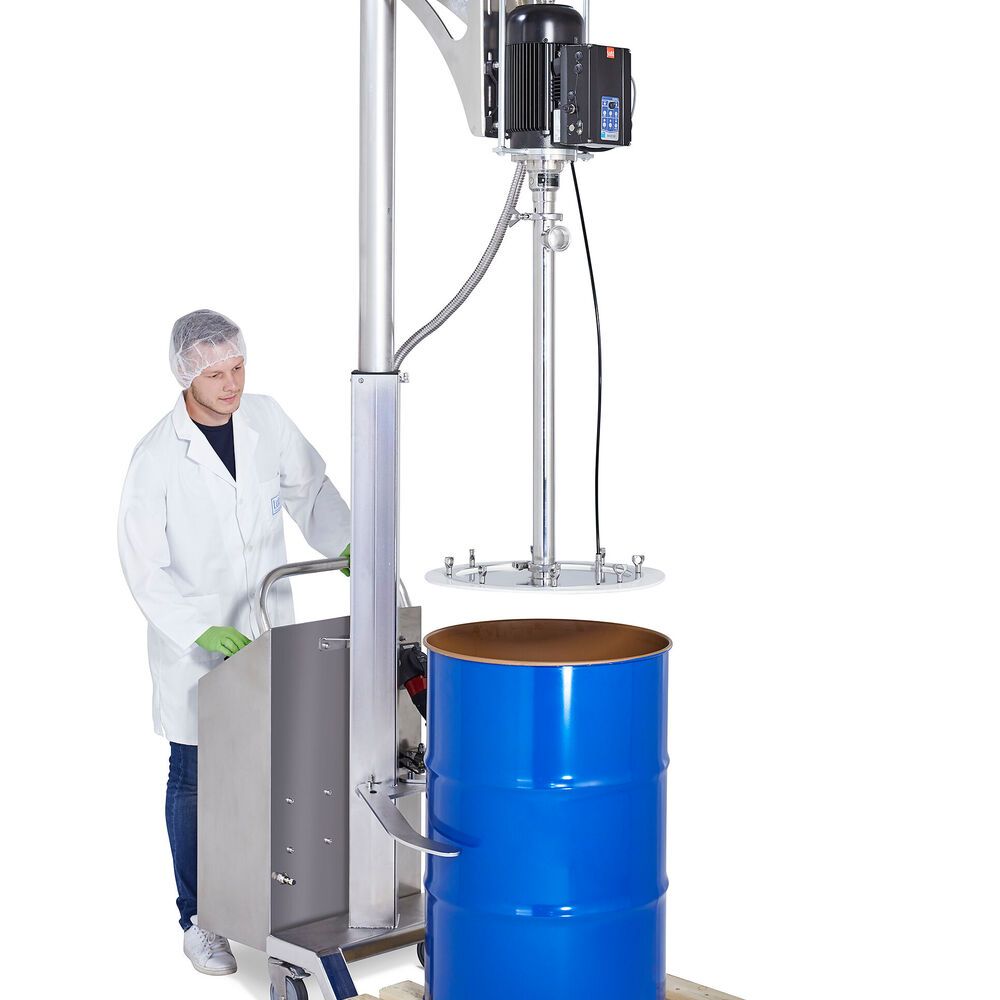
Unlike conventional immersed pumps, the SaniForce system uses the combination of a pneumatic pump with high pressure capacity coupled to a follower plate with an inflatable or flexible seal.
How the Process Works in Practice:
Drum Positioning: The 200 liter drum is positioned on the base of the equipment without the need for tilting or physical effort from the operator.
Descent of the Follower Plate: A pneumatic piston forces the follower plate downwards, entering the drum and perfectly sealing the internal edges.
Pressing and Cleaning Effect: As the plate descends, the scraper seal completely cleans the drum walls, pushing all the product towards the pump inlet installed in the center of the plate.
Forced Feeding: The pressure of the plate eliminates the formation of air pockets and feeds the pump continuously, allowing stable transfer of the product, regardless of its viscosity.
Total Evacuation: Upon reaching the bottom, the retained product is practically zero (reaching up to 99% removal), leaving the drum clean and ready for disposal or quick cleaning.
Additional Benefits for the Industrial Plant
Eliminating waste is just one of the benefits of the Graco SaniForce system:
Sanitary Compliance (FDA / 3-A / EHEDG): Designed in stainless steel with an electropolished sanitary finish, the equipment eliminates human contact with the fluid and meets the requirements of regulatory bodies such as ANVISA and MAPA.
Ergonomics and Occupational Health (EHS): Eliminates heavy handling of drums, reducing the risk of repetitive strain injuries (RSI/WMSD) or accidents with spills.
Reduction in CIP (Clean-In-Place) Time: As the drum is practically clean, washing time and water/detergent consumption for cleaning drops drastically.
Preservation of Product Texture: Continuous transfer without excessive shear maintains the consistency and organoleptic properties of foods, cosmetics and pharmaceuticals.
Optimize your Factory Transfer Process with Duplication
Continuing to use manual or improvised methods to unload viscous raw materials represents an invisible cost that eats into your operation's profit margin.
At Dupulação, we are experts in industrial pumping engineering and sizing sanitary systems for complex fluids.
How we can help your company:
Technical assessment of the viscosity and rheology of your product;
Sizing and specification of the ideal Graco SaniForce line for your production volume;
Supply of original spare parts, seals and technical support for maintenance.
Do you want to calculate the estimated savings for your production line?
Get in touch with Dupulação’s team of engineers at dualacao.com.br and request a personalized technical assessment!
To check the aforementioned normative parameters, consult the technical reference documentation on Empty high viscosity drum.
Empty High Viscosity Drum FAQ
Empty High Viscosity Drum: 1. What is the average percentage of product evacuation achieved by the Graco SaniForce?
The Graco SaniForce drum unloader achieves up to 99% container evacuation, minimizing residue trapped in the bottom and walls of 200 liter drums.
2. What types of products and viscosities can the drum unloader process?
The equipment is designed for medium to very high viscosity fluids (from 10,000 to more than 1,000,000 cPs) that do not flow spontaneously, such as: peanut butter, tomato paste, fruit concentrate, fillings, mascara, cosmetic creams, ointments and pharmaceutical syrups.
Does the system meet Brazilian and international health requirements and standards?
Yes. The SaniForce line is made of stainless steel with a sanitary finish and has international certifications such as FDA, 3-A and EHEDG, fully complying with the requirements of ANVISA and MAPA.
4. How does the follower plate prevent pump cavitation?
The follower plate is pressed by a pneumatic piston directly onto the raw material. This continuous seal forces the product toward the pump inlet, eliminating air entry and the formation of vacuum pockets during suction.
5. Is physical effort required by the operator to unload the drum?
No. The process is automated. The operator simply positions the drum on the base of the equipment and activates the pneumatic control so that the follower plate descends and scrapes automatically, promoting greater ergonomics and safety (EHS).