1. Graco Husky pump: models, applications and how to choose the ideal one for your industry
In the current context of innovation and high performance, understanding the applications of bomba graco husky: what applications is it ideal for? is fundamental. The Husky line brings together pumps of different sizes, capacities and construction materials. Depending on the model and configuration chosen, it is possible to work with different flows, pressures, viscosities and fluid characteristics.
But which model to choose? And for what applications is the Graco Husky pump recommended?
In this article, we will present the main characteristics of the technology, some models in the Husky line and the factors that must be evaluated before specification.
What is a Graco Husky pump?
Husky is a family of pneumatic double diaphragm (AODD – Air-Operated Double Diaphragm) pumps. The equipment uses compressed air as a drive source to move the diaphragms and transfer the fluid.
An important feature of this system is the absence of a conventional mechanical seal in direct contact with the fluid, which can be advantageous in certain transfer applications.
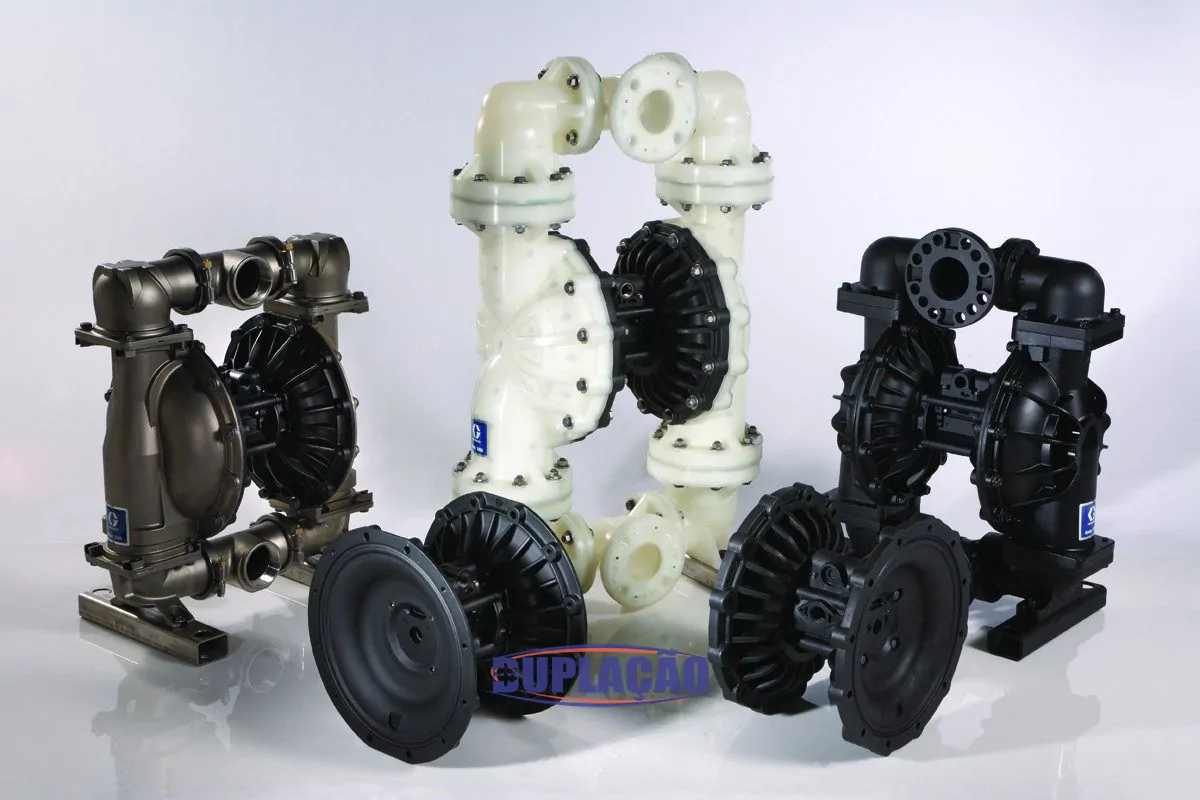
The Husky line has models with different connection sizes and materials for the wetted parts, allowing the equipment to be configured according to the characteristics of the pumped product.
According to Graco, the Husky family can reach 1,135 L/min (300 gpm) of flow, with models that have connections from 1/4″ to 3″, depending on the version.
How does a double diaphragm pneumatic pump work?
The operating principle is relatively simple.
The pump has two diaphragms connected by a shaft. Compressed air is directed alternately to each side of the pneumatic system, causing one diaphragm to advance while the other returns.
This movement creates suction and discharge cycles that allow the fluid to be transported.
The process is repeated continuously, pumping the product.
As the activation is carried out by compressed air, the technology may be interesting for installations in which the use of electrical equipment directly at the pumping point is not desirable or in which there is already a compressed air network available.
Key Advantages of Graco Husky Pumps
The Husky line was developed for industrial applications that require robustness, flexibility and ease of maintenance.
Among the features highlighted by Graco are:
✔️ Pneumatic drive;
✔️ Lubrication-free operation;
✔️ Low pulsation, non-sticking air valve in various models;
✔️ Robust construction;
✔️ Different material options for contact with the fluid;
✔️ Ease of maintenance;
✔️ Various size and configuration options;
✔️Possibility of application in different types of fluids;
✔️Flows that can reach 1,135 L/min, depending on the model.
Another important point is the modular air valve. Graco highlights that it allows a quick and smooth change of the pumping cycle, contributing to a more efficient operation with less pulsation.
2. Discover some models of Graco Husky pumps
The Husky family has several models. The choice depends mainly on the required flow, pressure, characteristics of the fluid, size of connections and construction materials.
Among the models found in the line are Husky 205, 307, 515, 716, 1050, 1590, 2150 and 3300.
Below, we highlight some of the most used models in industrial applications.
🔹Husky 1050
The Husky 1050 is a double diaphragm pneumatic pump with a 1″ connection, suitable for a wide variety of transfer applications.
According to Graco specifications, the model can reach up to 189 L/min (50 gpm) and maximum working pressure of up to 8.6 bar (125 psi) in certain configurations.
The Husky 1050 features a low-pulsation, non-sticking air valve and a one-piece center section, features that Graco attributes to reduced leaks and ease of maintenance.
🤔Where to use Husky 1050?
Due to its intermediate size, the Husky 1050 can be used in different transfer operations, such as:
☑️ Transfer of chemical products;
☑️ Paints and coatings;
☑️ Oils and lubricants;
☑️ Equipment supply;
☑️ Transfer between tanks and containers;
☑️ General industrial applications.
There are specific configurations of the Husky 1050 intended, for example, for oil transfer and evacuation.
It is important to note that the final application depends on the equipment configuration and the compatibility of the pump materials with the fluid.
🔹Husky 1590
The Husky 1590 has 1½" connections and can reach approximately 378.5 L/min (100 gpm) in free flow conditions, according to the configuration indicated by Graco. Its maximum working pressure reaches approximately 8.4 bar (120 psi).
It is an alternative for processes that require a greater transfer capacity than that offered by the Husky 1050.
Depending on the configuration, the model can be found with different construction materials, allowing it to be adapted to different types of fluids.
Possible applications
The Husky 1590 can be considered for:
☑️Industrial transfer processes;
☑️Compatible chemical products;
☑️Paints and coatings;
☑️Process fluids;
☑️Oils and other industrial liquids;
☑️Operations that require greater flow.
The specification of diaphragm materials, balls, seats and other components must be made considering the characteristics of the product.
🔹Husky 2150
For applications that require an even greater flow, the Husky 2150 has 2″ connections and a capacity of up to 568 L/min (150 gpm), according to Graco. The maximum indicated fluid pressure is 8.4 bar (120 psi).
Graco highlights the Husky 2150's low-pulsation, non-sticking air valve, as well as lubrication-free operation and external access to the valve for easier maintenance.
For which applications is the Husky 2150 suitable?
The model can be used in processes where greater transfer capacity is required, including:
☑️Transfer of chemical products;
☑️Industrial processes;
☑️Paints and coatings;
☑️Process fluids;
☑️Transfer of liquids between tanks;
Equipment supply and power operations.
The choice of construction material must follow the composition and characteristics of the fluid.
🔹Husky 3300
When the process requires large transfer volumes, the Husky 3300 is one of the highest capacity models in the family.
The model has a 3″ connection and can reach up to 1,136 L/min (300 gpm) of free flow, according to Graco documentation.
Depending on the configuration, the Husky 3300 can use different materials for the central section and the parts in contact with the fluid. Graco documentation presents versions in materials such as aluminum and polypropylene, as well as different combinations of components.
🔹Husky 3300 applications
Due to its flow capacity, this model can be considered for large volume processes, such as:
☑️Transfer of large volumes of liquids;
☑️High demand industrial processes;
☑️Tank supply;
☑️Transfer of compatible chemicals;
☑️Processes that require greater pumping capacity;
☑️Transfer operations in industrial systems.
Naturally, the maximum capacity stated by the manufacturer does not mean that it will be reached under all operating conditions. Flow, pressure, viscosity, suction height, piping and fluid characteristics directly influence performance.
🔹Husky 515 and Husky 716: compact models
In addition to the larger capacity models, the Husky family also has smaller options.
🔹The Husky 515, for example, has a compact construction and a low-pulsation, non-sticking air valve. Graco also highlights its fluid cover connection system using screws, developed to provide a reliable seal.
🔹The Husky 716 has an external controller, allowing remote control capabilities in certain configurations. The model also has different door options and does not use conventional mechanical seals.
These models may be interesting for applications that do not require the pumping capacity of larger models.
3. What fluids can be pumped with a Husky?
One of the most important features of double diaphragm pneumatic pumps is the possibility of working with a wide variety of fluids.
Depending on the configuration, a Husky pump can be used to:
☑️Chemical products;
☑️Paints;
☑️Varnishes;
☑️Coatings;
☑️Oils;
☑️Lubricants;
☑️Industrial fluids;
☑️Stickers;
☑️Process products;
Liquids with certain concentrations of suspended solids.
However, it is not correct to choose a pump solely based on the type of fluid.
The same product may require different settings depending on its viscosity, temperature, concentration, abrasiveness and chemical composition.
Therefore, the chemical compatibility between the fluid and the wetted components of the pump is one of the main points of the specification.
The importance of construction materials
One of the differentiators of the Husky line is the availability of different materials to meet the characteristics of each application.
Materials that may appear in different configurations include aluminum, stainless steel, polypropylene, PVDF and other specific materials, depending on the model and configuration.
It is also necessary to correctly select components such as:
☑️ Diaphragms;
☑️Spheres;
☑️ Headquarters;
☑️O-rings;
Body and parts in contact with the fluid.
Incorrect selection of these components may result in premature wear, loss of performance or chemical incompatibility.
Therefore, the specification must be made considering the fluid and the real operating conditions, and not just the desired flow rate.
4. How to choose the right Graco Husky pump?
Before defining a model, some data is essential.
- What is the fluid?
Provide the commercial name and, when possible, the chemical composition of the product.
- What is the viscosity?
Viscosity directly influences the pumping capacity and flow obtained in the application.
- What flow is needed?
Define how many liters per minute the process needs to transfer.
- What is the discharge pressure?
The pump must be specified considering the pressure required at the discharge point, and not just the flow rate.
- What is the temperature of the product?
High or very low temperatures can alter fluid properties and material compatibility.
- Are there solids in suspension?
If the product contains particles, it is important to know the size and concentration of the solids. The different Husky pumps have different capacities for passing solids. For example, Graco documentation indicates approximately 3.2 mm for the Husky 1050, 4.8 mm for the 1590, 6.3 mm for the 2150, and 13 mm for the 3300.
- What is the availability of compressed air?
As the pump is pneumatic, it is necessary to evaluate the pressure and capacity of the available compressed air network.
Why rely on a company specialized in specification?
The choice of an industrial pump should not be based solely on the size of the connection or the maximum flow indicated in the catalogue.
An adequate specification considers the entire application set: fluid + flow + pressure + temperature + viscosity + solids + materials + installation conditions.
An oversized pump can result in unnecessary compressed air consumption and higher operating costs. Undersized equipment may not meet the process demands.
Therefore, having professionals who know pumping technology helps you find a suitable configuration for each need.
Graco Husky pump: versatility for different industrial processes
The Graco Husky line offers a wide variety of pneumatic double diaphragm pumps, from compact models for smaller applications to equipment capable of moving large volumes of fluids.
Models such as Husky 1050, 1590, 2150 and 3300 have different flow capacities and connection sizes, allowing processes with very different needs to be met.
The choice of equipment, however, must always consider the specific characteristics of the process and fluid.
Need to find the right Graco Husky pump for your application? Get in touch with our team. Inform the fluid that will be pumped, flow, pressure, temperature and installation conditions, and we can evaluate the most appropriate configuration for your needs.
To deepen your technical knowledge and consult international regulatory standards, see more data about graco husky pump: what applications is it ideal for?.
Conclusion: Strategic Summary and Next Steps
The Graco Husky pump stands out as an effective solution for various industrial applications. By adopting recommended good practices and paying attention to industry innovations, their implementation can result in significant operational and economic improvements.
Frequently Asked Questions about the Graco Husky pump: what applications is it ideal for?
What are the main applications of the Graco Husky pump? in Practice with a Graco Husky pump: for which applications is it ideal?
The Graco Husky pump is ideal for the food industry, pharmaceuticals, industrial painting, chemical handling and sanitary applications, providing efficiency and safety.
How can I optimize the use of the Graco Husky pump?
Optimization can be achieved through training, preventive maintenance, performance monitoring and adoption of good operational practices.
How long does the Graco Husky pump last?
The pump's durability depends on proper use and maintenance, but with proper care, it can provide years of reliable service.
What are the costs associated with implementing the Graco Husky pump?
Initial costs include purchase and installation, but the long-term benefits, such as efficiency and reduced operating costs, are worth the investment.
What sets the Graco Husky pump apart from its competitors?
Differentiators include energy efficiency, adaptability to different applications, ease of maintenance and specialized technical support from Graco.