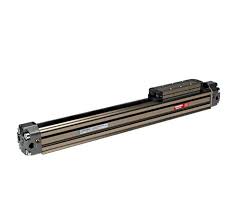
Os linear pneumatic cylinders without rod are devices that convert the energy of compressed air into linear movement. They are designed to provide linear motion in a variety of industrial applications and are especially useful when there are space constraints or when smooth, wobble-free movement is required.
Here's a summary of how they work:
Working Principle: Rodless linear pneumatic cylinders operate based on the principle of an internal piston moving within a cylindrical tube.
Construction: Unlike conventional pneumatic cylinders, which have a rod that extends and retracts, rodless linear pneumatic cylinders have no external rod. Instead, the internal piston is coupled directly to the load being moved.
Sealing System: These cylinders are equipped with special sealing systems to ensure smooth and efficient movement, preventing air leaks.
Compressed Air Pressure: When compressed air is introduced into the cylinder chamber, pressure is created that pushes the internal piston out of the chamber. This movement is used to move the load attached to the end of the cylinder.
Return: For retraction, the air pressure in the chamber is released, allowing the cylinder's internal spring or ambient pressure to push the piston back to its starting position.
Applications: These cylinders are widely used in applications where precise, smooth, external rodless linear motion is required, such as packaging machines, automation equipment, fixtures and material handling systems.
Rodless linear pneumatic cylinders offer advantages such as high precision, low maintenance and high load capacity, making them a popular choice in various industries.
Know more: