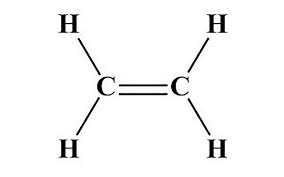
Chemical, physical and thermal properties of the ethylene, also called ethylene, acethene and olephics. Phase diagram included.
O etiileno, c 2 H 4 , It is a highly flammable, colorless and not corrosive gas with sweet odor. It is easily inflamed and a flame can easily return to the leak source. Under prolonged exposure to fire or heat, containers may break violently and explode. It can cause explosion. Vapors from boiling fluid are lighter than air. The ethylene is not toxic, but is a simple asphyxiating.
Ethylene is used as anesthetic, soda and to make other chemicals such as polymers and plastics.
Ethylene is produced in petrochemical processes, such as steam cracking , where hydrocarbons and vapor are heated at 750–950 ° C. This process converts large hydrocarbons to smaller and introduces unsaturated products.
The ethylene phase diagram is shown below the table.
Chemical, physical and thermal properties of the ethylene:
The values are provided for the gas phase at 25 o C /77 o F / 298 k and 1 bara, if not another phase, temperature or pressure indicated.
| Property | Valor | Unit | Valor | Unit | Valor | Unit | Valor | Unit | |||
| Self -ignition temperature | 723 | K | 450 | °C | 842 | °F | |||||
| Boiling point | 169 | K | -104 | °C | -155 | °F | |||||
| Critical density | 7,63 | mol/dm 3 | 214 | kg/ M3 | 0,415 | SLESMA/FOOT 3 | 13,4 | lb/whate 3 | |||
| Critical pressure | 5.06 | MPa = MN/ M2 | 50,6 | bar | 49,9 | ATM | 734 | psi = lb f /in 2 | |||
| Critical temperature | 282,4 | K | 9.2 | °C | 48,6 | °F | |||||
| Critical volume | 131 | cm3 / mol | 0,00467 | M3 / kg | 2,41 | feet 3 /slug | 0,0748 | feet 3 /lb | |||
| Density | 40,6 | mol / M3 | 1.138 | kg/ M3 | 0,00221 | SLESMA/FOOT 3 | 0,07104 | lb/whate 3 | |||
| Density (liquid) to -104 ° C/-155 ° F | 20567 | mol / M3 | 577 | kg/ M3 | 1.12 | SLESMA/FOOT 3 | 36,0 | lb/whate 3 | |||
| Flammable, gas and liquid | sim | highly | |||||||||
| Flash point | 137 | K | -136 | °C | -213 | °F | |||||
| Gas constant, individual, r | 296,4 | J/kg K | 0,0823 | Wh/(kg K) | 1772 | [ft lb f /slug °R] | 55,08 | [ft lb f /lb °R] | |||
| GIBBS Free Energy (gas) | 68 | kJ/mol | 2424 | kJ/kg | 1042 | Btu/lb | |||||
| Combustion heat (enthalpy) (gas) | -1411 | kJ/mol | -50303 | kJ/kg | -21626 | Btu/lb | |||||
| Heat (enthalpy) of training (gas) | 52,4 | kJ/mol | 1868 | kJ/kg | 803 | Btu/lb | |||||
| Heat (enthalpy) of evaporation to -104 ° C/-155 ° F | 13.6 | kJ/mol | 483 | kJ/kg | 207,7 | Btu/lb | |||||
| Heat capacity, CP (gas) | 42,9 | J/mol k | 1,53 | kJ/kg K | 0,365 | Btu/lb°F ou cal/g K | |||||
| Heat capacity, CP (liquid) to -104 ° C/-155 ° F | 67,4 | J/mol k | 2,40 | kJ/kg K | 0,574 | Btu/lb°F ou cal/g K | |||||
| Heat capacity, CV (gas) | 34,6 | J/mol k | 1,24 | kJ/kg K | 0,295 | Btu/lb°F ou cal/g K | |||||
| Heat capacity, CV (liquid) to -104 ° C/-155 ° F | 38,7 | J/mol k | 1,38 | kJ/kg K | 0,330 | Btu/lb°F ou cal/g K | |||||
| Ionization potential | 10,5 | eV | |||||||||
| log K OW (Octanol/water partition coefficient) | 1.13 | ||||||||||
| Melting point | 104,15 | K | -169,0 | °C | -272,2 | °F | |||||
| Molecular weight | 28.054 | g/mol | 0,06185 | lb/mol | |||||||
| Water solubility, at 25 ° C | 0,131 | mg/ml | |||||||||
| Sound speed | 330 | EM | 1082 | pump/s | 739 | Wed/h | |||||
| Specific gravity (gas) (air related) | 0,978 | ||||||||||
| Specific heat ratio (gas) - C P /C V | 1,24 | ||||||||||
| Specific heat ratio (liquid) - C P /C V | 1,74 | ||||||||||
| Specific volume | 0,0247 | M3 / mol | 0,879 | M3 / kg | 453 | feet 3 /slug | 14.1 | feet 3 /lb | |||
| Standard molar entropy, s ° (gas) | 219,32 | J/mol k | 7,82 | kJ/kg K | 1,87 | Btu/lb °F | |||||
| Standard molar entropy, S ° (liquid) | 117,8 | J/mol k | 4,20 | kJ/kg K | 1,00 | Btu/lb °F | |||||
| Surface tension A -104 ° C/-155 ° F | 16h00 | Dinas/CM | 0,016 | N/m | |||||||
| Thermal conductivity | 0,020 | A/m°C | 0,0118 | Btu/h ft °F | |||||||
| Triple point pressure | 0,000122 | MPa = MN/ M2 | 0,00122 | bar | 0,00120 | ATM | 0,0177 | psi = lb f /in 2 | |||
| Triple point temperature | 104,0 | K | -169,16 | °C | -272,49 | °F | |||||
| Steam pressure (saturation) | 6,9449 | MPa = MN/ M2 | 5.21E+04 | mm Hg | 68.543 | ATM | 1007,30 | psi = lb f /in 2 | |||
| Viscosity, dynamic (absolute) | 0,0103 | cP | 6.9 | [lb m /feet*10 -6 ] | 0,22 | [lbf s /feet 2 *10 -6 ] | |||||
| Viscosity, kinematics | 9,05 | cSt | 97,4 | [feet 2 /s*10 -6 ] |
Ethylene is a gas under standard conditions. However, at low temperatures and/or high pressures, the gas becomes liquid or solid.
The ethylene phase diagram shows phase behavior with temperature and pressure changes. The curve between the critical point and the triple point shows the boiling point of the ethylene with changes in pressure. It also shows saturation pressure with changes in temperature.
No critical point There is no state change when pressure is increased or if heat is added.
O triple of a substance is the temperature and pressure in which the three phases (gas, liquid and solid) of this substance coexist in thermodynamic balance.
Source: https://www.engineeringtoolbox.com/ethylene-thene-c2h4-properties-d_2104.html